
JAZZ
TRAINING
WORKBOOK

The Jazz Training Workbook is a community-driven training book. This means YOU can decide what goes into it.


Help is finally here.
Because jazz is improvisation-based, it can be very difficult, frustrating, even discouraging to learn. I am a classically trained musician who has been teaching himself how to play jazz for over a decade.
Through transcribing several hundreds of jazz piano arrangements and analyzing them, I have uncovered patterns, techniques and systems in improvisation. I use these systems to teach myself improvisation and jazz techniques, and share them with you!
~Timothy Gondola
The Jazz Training Workbook is:
-
I am taking all of your suggestions and requests, combining them with my own expertise, ideas, and practice techniques and am creating a more wholistic jazz training method.
-
What do you want to learn? What do you need help with? Your requests and suggestions are determining the structure, content, and direction of this workbook.
-
Some of us have several available hours a day to practice. Some of us barely have 5 minutes. You'll be able to choose from multiple practice routines that fit with your schedule.
-
As we walk through the various exercises, you'll find helpful explanations that explain the concepts clearly. Pair this with the free Jazz Starter Pack and Study Notes to master the material.
What Students Are Saying

- Az Samad, Composer, Malaysia
In the Jazz Training Workbook, pianist and educator Timothy Gondola has managed to assemble 209 pages of jazz education gems. Each page contained concepts, examples, ideas and suggestions that will translate into hours of practice. There's so much in here and with each practice session from the workbook, it's helped me come back to the fundamentals that help make us all better jazz musicians.
Thanks Timothy!
Isidoro Fiore, Italy
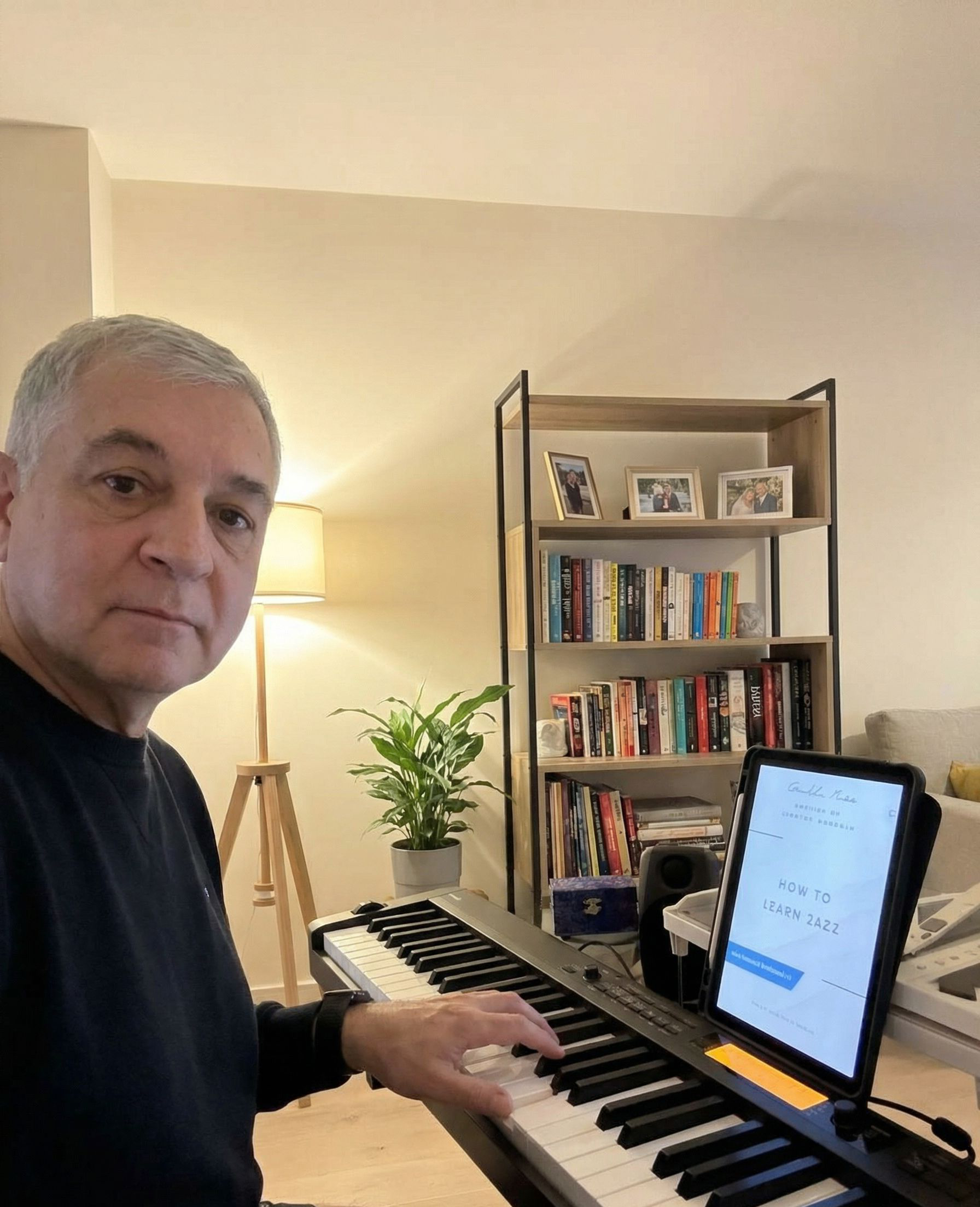
"This workbook has significantly improved my approach to jazz, offering clarity, structure, and immediately usable ideas. A highly effective and inspiring guide to jazz. It transforms complex concepts into practical, playable skills from day one."

Andrea Mazzolini, Italy
"Timothy’s Jazz Training Workbook is a well-structured and valuable resource. The material progresses clearly and logically. Timothy demonstrates each concept through musical examples connected to standard repertoire, which helps bridge the gap between theory and real playing situations. The explanations are precise and focused, avoiding unnecessary complication while maintaining musical rigor.
Overall, this tutorial has been a big help towards improving my comping and improvisation, expanding my harmonic awareness and improving my consistency at the instrument."
Community Input.
![[Part 1] Jazz Training Workbook | Train Your Mind | 4 Lessons](https://images.squarespace-cdn.com/content/v1/62f41bb389394805790fcf57/09375632-6c35-4054-aa44-3bb3dee441b3/Part+1.png)
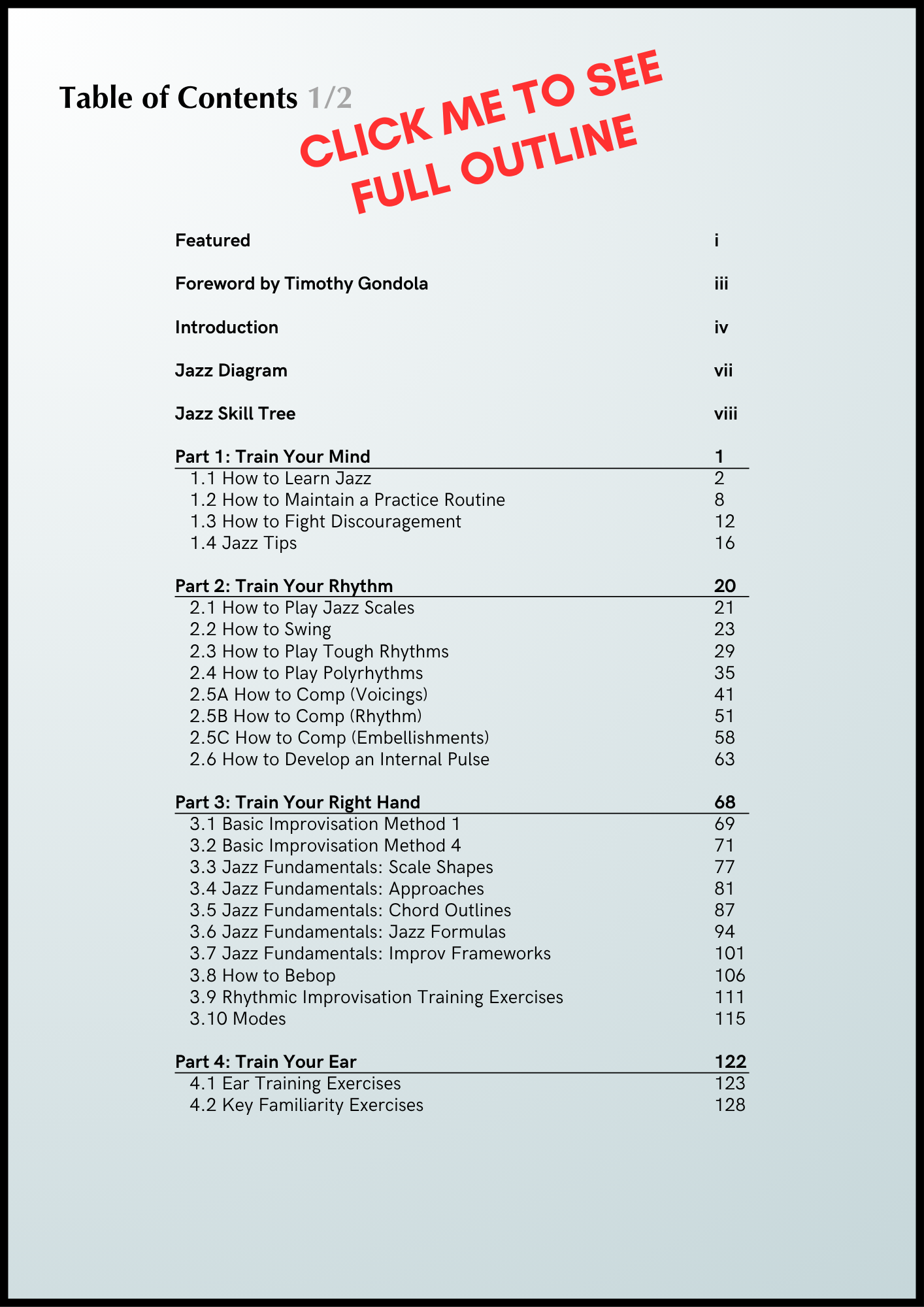
Part 1/7 of the Jazz Training Workbook. This section focuses on the proper mindset to have before embarking on your jazz apprenticeship.
PDF format.
The lessons herein:
1.1 How to Learn Jazz
1.2 How to Maintain a Practice Routine
1.3 How to Fight Discouragement
1.4 Jazz Tips
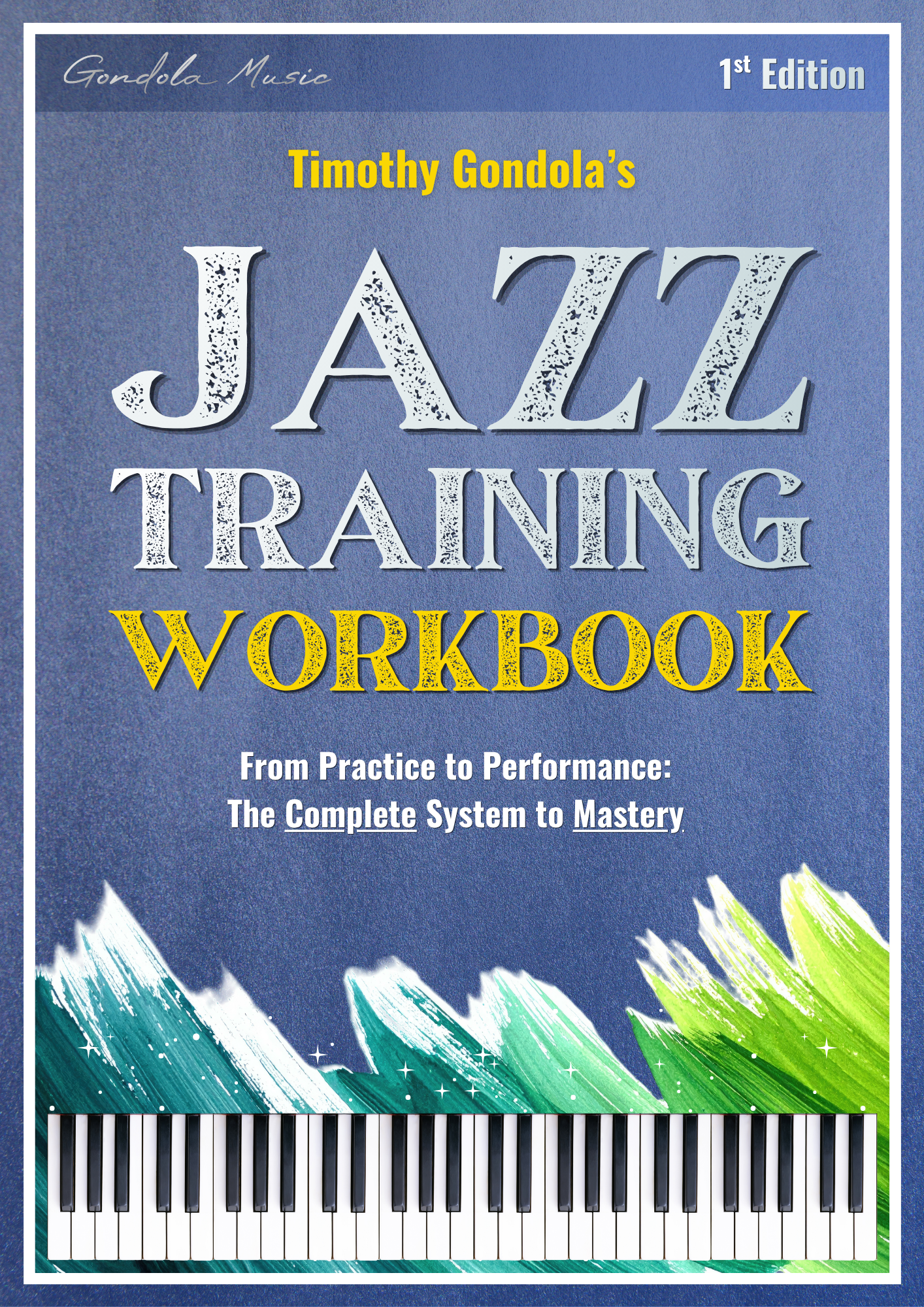
The Jazz Training Workbook is Timothy Gondola’s magnum opus. Currently in PDF form, I have future plans for print form.
✓ 300 pages
✓ 34 jazz lessons organized by topic
✓ Custom practice routines
✓ Color-coded notation
✓ Advice and tips from Timothy
✓ Listening examples
✓ Practice applications
✓ Exercises
This is your training workbook, the one you’ve been waiting for.
![[Part 2] Jazz Training Workbook | Train Your Rhythm | 8 Lessons](https://images.squarespace-cdn.com/content/v1/62f41bb389394805790fcf57/29372a81-6eac-4e8d-96d2-76a265a4521c/Part+2.png)
Part 2/7 of the Jazz Training Workbook. This section focuses on rhythmic training, one of core foundations of jazz.
PDF format.
The lessons herein:
2.1 How to Play Jazz Scales
2.2 How to Swing
2.3 How to Play Tough Rhythms
2.4 How to Play Polyrhythms
2.5A How to Comp (Voicings)
2.5B How to Comp (Rhythm)
2.5C How to Comp (Embellishments)
2.6 How to Develop an Internal Pulse
![[Part 3] Jazz Training Workbook | Train Your Right Hand | 10 Lessons](https://images.squarespace-cdn.com/content/v1/62f41bb389394805790fcf57/03932e88-222f-4423-9820-722de94c851d/Part+3.png)
Part 3/7 of the Jazz Training Workbook. This section is my favorite part of the workbook. It teaches how to build the improvised right hand lines we hear the greats play.
PDF format.
The lessons herein:
3.1 Basic Improvisation Method 1
3.2 Basic Improvisation Method 4
3.3 Jazz Fundamentals: Scale Shapes
3.4 Jazz Fundamentals: Approaches
3.5 Jazz Fundamentals: Chord Outlines
3.6 Jazz Fundamentals: Jazz Formulas
3.7 Jazz Fundamentals: Improv Frameworks
3.8 How to Bebop
3.9 Rhythmic Improvisation Training Exercises
3.10 Modes
![[Part 5] Jazz Training Workbook | Train Your Mind | 6 Lessons](https://images.squarespace-cdn.com/content/v1/62f41bb389394805790fcf57/8814913f-1404-450f-975e-025491b9d649/Part+5.png)
Part 5/7 of the Jazz Training Workbook. This section focuses on chord progressions, voicings and techniques.
PDF format.
The lessons herein:
5.1 How to Spice Up Your Chords
5.2 Top 10 Most Common Jazz Chord Progressions
5.3 Hand Independence
5.4 The 251
5.5 7th Chord Positions
5.6 Barry Harris 6th Diminished Scale
![[Part 4] Jazz Training Workbook | Train Your Ear | 2 Lessons](https://images.squarespace-cdn.com/content/v1/62f41bb389394805790fcf57/f13e406c-6b45-4d72-8c63-063a8a0319c2/Part+4.png)
Part 4/7 of the Jazz Training Workbook. This section focuses on developing a good jazz ear through ear training and key familiarity exercises.
PDF format.
The lessons herein:
4.1 Ear Training Exercises
4.2 Key Familiarity Exercises
![[Part 7] Jazz Training Workbook | Practice Routines | 6 Lessons](https://images.squarespace-cdn.com/content/v1/62f41bb389394805790fcf57/4b2a6819-2472-4ea3-910b-fab9c0d3b29b/Part+7.png)
Part 7/7 of the Jazz Training Workbook. In this final section, I hand-selected key exercises and lessons from the workbook to package into practice routines for you.
Choose a routine based on your proficiency (beginner, intermediate, advanced) and how much time you have to practice per day (10 minutes, 30 minutes, 1 hour, 2 hours).
PDF format.
The lessons herein:
7.1 Overview
7.2 Practice Routine Cheatsheets)
7.2 10-Minute Daily Practice Routine
7.3 30-Minute Daily Practice Routine
7.4 1-Hour Daily Practice Routine
7.5 2-Hour Daily Practice Routine
![[Part 6] Jazz Training Workbook | Train Your Playing | 5 Lessons](https://images.squarespace-cdn.com/content/v1/62f41bb389394805790fcf57/14390105-3522-433f-836c-dd0321077de9/Part+6.png)
Part 6/7 of the Jazz Training Workbook. This section focuses on overall playing strategies and performance.
PDF format.
The lessons herein:
6.1 How to Play a Lead Sheet (Left Hand)
6.2 How to Structure a Solo
6.3 How to Play with a Band
6.4 How to Master a Jazz Standard
6.5 Improvisation Models